
India is one of the few nations, and perhaps the only nation, that has good relations with America, Israel and Iran. Knowing that a war in the Gulf would damage our economy, hurt supply of fertilisers and fuel, and cause general chaos, we should have tried to ensure this war did not begin, asserts Aakar Patel.

Israeli Prime Minister Benjamin Netanyahu has asserted that Iran is no longer capable of enriching uranium or producing ballistic missiles, following a joint military campaign with the US.
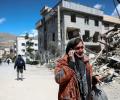
Fleur Hassan-Nahoum, special envoy, foreign ministry of Israel, has asserted that the situation has effectively been a "multi-front regional conflict" since its inception, while claiming significant military and strategic gains against adversarial forces.

Falling debris from an intercepted Iranian drone caused a 'limited fire' at Saudi Aramco's Ras Tanura refining facility in Saudi Arabia, Saudi Defence Ministry spokesperson Turki Al-Maliki said, according to Al Arabiya.

Prime Minister Narendra Modi was conferred with the 'Speaker of the Knesset Medal' in recognition of his contribution to strengthening strategic relations between India and Israel, making him the first leader to receive this honor.

The incident came shortly after a spokesperson from Iran's military warned that Tehran could target ports and docks in the United Arab Emirates following recent United States strikes on Kharg Island, a key hub for Iran's oil exports.

Addressing the Israeli Parliament, the Knesset, Modi offered his deepest condolences to the people of Israel for every life lost in the terrorist attack by Hamas on October 7, 2023.
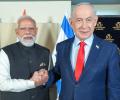
The Congress party has criticised the Indian government's diplomatic strategy, claiming a 'severe setback' if reports of Pakistan mediating between the US-Israel and Iran are accurate. The party alleges Pakistan's diplomatic engagement has surpassed India's, despite military successes.

The Israeli Air Force has destroyed an aircraft used by Iranian leadership at Mehrabad International Airport in Tehran, along with striking over 200 targets across western and central Iran, significantly impacting Iran's strategic capabilities.

The West Asia conflict escalated sharply as Iran launched missiles towards Israel, while Tehran confirmed the killing of its intelligence minister in Israeli strikes, marking the third assassination of a senior Iranian official in two days.

United States and Israeli officials are assessing potential policy options in response to ongoing unrest in Iran, according to multiple indications received by Israeli media reports The Jerusalem Post.

India and Israel have strongly condemned terrorism in all its forms, including cross-border terrorism, and reaffirmed their commitment to combating the threat.
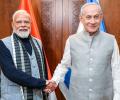
India and Israel share a deep historical bond, and Prime Minister Modi's visit to the Knesset marked a bold shift from past diplomatic hesitation to open strategic partnership.

In a post on X, Netanyahu wrote, 'Before our joint dinner, I surprised my friend Prime Minister Modi by wearing traditional Indian attire.'
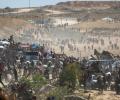
India has joined over 100 countries and global organizations in condemning Israel's "unilateral" decisions and measures aimed at expanding its "unlawful presence" in the West Bank.

The Israeli Air Force (IAF) said it struck several targets in Tehran, Shiraz and Ahvaz simultaneously over the past 24 hours, targeting sites linked to Iran's ballistic missile programme, air defence systems and military headquarters.

The intriguing bit is that Trump is likely to attend the talks in Islamabad this weekend -- if he does, it will be the clearest signal yet that the US is ready to exit the war with some sort of win to show, since he cannot afford to go for the talks and return empty-handed, notes Prem Panicker in his must read blog on the Iran War

This threat comes as the assembly of experts in Iran has reportedly reached a majority consensus regarding the successor to the late Supreme Leader Ayatollah Ali Khamenei, according to the Tehran-based Mehr News Agency (MNA).

Israel initiated military action against Iran shortly after Prime Minister Narendra Modi's visit, capitalising on a fleeting opportunity and years of strategic preparation, according to Israel's ambassador to India.

'In such a scenario, Iran could proclaim itself victor, rebuild, re-enforce its diminished regional proxies to further destabilise neighbouring nations and take control of the Persian Gulf and Strait of Hormuz.'

The core issues to be settled -- access to Hormuz, Israel's aggression in Lebanon, the question of Iran's nuclear programme, sanctions relief and compensation -- are thorny enough to require weeks of patient negotiation. The most likely outcome of the opening sessions is that both sides take the measure of each other, establish what is and is not negotiable, and return home without having broken anything. That would count as progress.

The Indian embassy in Tehran has earlier stated that it is facilitating the safe movement of nationals who wish to leave Iran.

'What we have yet to see on either the US or the Iranian side is willingness to compromise on their ultimate demands and the flexibility to reach an agreement to end the war.

Iraq want their World Cup qualifier against Palestine next month moved from the Jordanian capital of Amman, having also knocked back a Palestinian proposal to stage the match just outside Jerusalem.

Alliances fight wars effectively only when they share an endgame. If Israel acted without US knowledge, then the military alliance is operating without real coordination at the level of strategic targeting. Neither picture is reassuring in a war that is no longer regional in its consequences. Prem Panicker continues his must read daily blog on the Gulf War.

US-Israel air attacks intensified on the seventh day of war, striking Tehran and other Iranian cities.

If the Iranian regime needs to be punished for promoting quasi-terrorist outfits like Hezbollah and Hamas, then what about Pakistan which has spent decades exporting terror around the world, killing thousands, particularly in Afghanistan and India? asks M R Narayan Swamy.

Dubai's core promise -- that it is an oasis untouched by regional storms -- has been tested in full public view. The coming months will show whether investors view the attacks as a short-lived disruption or a deeper signal of lasting risk, points out Asif Ullah Khan.

As days turn into weeks and America loses more planes, as the destruction of trillions of dollars worth military assets piles up, and dead bodies of soldiers return in ever greater numbers in coffins, Trump will have to answer some very difficult questions to save his presidency, notes Ambassador M K Bhadrakumar.

Iran launched retaliatory military strikes targeting Israel and American military bases across the region, including in Qatar, the United Arab Emirates, Kuwait, Bahrain and Jordan.
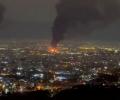
To be sure, Trump is furious, as the trajectory of the war is in a state of Zugzwang, as chess players call it. Trump and Netanyahu stare at two choices -- retreat in humiliation and concede Tehran's demands -- recognition of its rights, reparations, and binding security guarantees -- or perish in a quagmire, points out Ambassador M K Bhadrakumar.
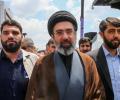
'Mojtaba Khamenei supervised the most recent repression in December 2025 and January 2026 which remains ongoing.'

The United States, which entered this war in expectation of a short, sharp win along the Venezuela model, is now preparing for deeper involvement in a conflict it does not fully control, without the allies it typically relies on, against an adversary that is not behaving as expected, in a global environment that is already absorbing economic shock. Prem Panicker continues his must read daily blog on the Gulf War.

Prime Minister Narendra Modi's upcoming visit to Israel is facing political complications as opposition leader Yair Lapid threatens to boycott his parliamentary address unless the Supreme Court chief is invited, adhering to standard protocol.

Prime Minister Narendra Modi addressed the Israeli Parliament, reaffirming India's support for Israel in the face of terrorism and expressing support for the Gaza peace initiative.

The pause gives the US time to breathe, to regroup, to move its expeditionary force into position without risk of interception along the way. It gives Iran nothing -- on the ground, attacks against its infrastructure continue apace. Prem Panicker in his must read daily blog on the Gulf War.

'We need to give Pakistan something serious to think about on its eastern front -- that is the only way to actually help Afghanistan right now.'

India and Israel have elevated their relationship to a special strategic partnership, focusing on enhanced cooperation in trade, technology, and defense, while also addressing regional peace initiatives.

Iran is fighting a different war: Older, slower, and in some ways more dangerous. Iran doesn't need to shoot down an F/A-18. It only needs to make the Strait of Hormuz feel dangerous long enough for insurance markets, shipping companies, and oil futures traders to do the rest. Prem Panicker continues his must-read daily blog on the war in the Middle East.

At least three Israelis were killed and six others injured when Palestinian gunmen opened fire at a bus stop in Jerusalem, breaking an uneasy peace in the city since the outbreak of the current round of violence in the region.
